Campus Operations and Planning is evaluating how services are funded and delivered across campus with the goal of improving transparency, consistency, and alignment between service delivery and funding sources.
No billing changes have been finalized at this time. If changes move forward, they would take effect no earlier than September 1, 2027. This timeline will allow campus units to engage in discussions, assess and prepare for potential impacts, support necessary system integrations, and plan proactively through the annual budget process.
Frequently Asked Questions
What is being reviewed?
Campus Operations and Planning is reviewing how services are delivered and funded across campus. The review is intended to improve understanding of current practices, engage stakeholders, increase transparency, and inform future planning.
Three primary areas are currently under review:
1. Building Services: Campus Operations provides general upkeep and maintenance services for buildings.
Campus Operations and Planning is reviewing how building-related services are funded and delivered across colleges, schools, units, auxiliary enterprises, and external entities on campus.
This review includes assessing services that may currently be centrally funded, directly billed, or supported through a combination of funding sources. The goal is give both Campus Operations and Planning and CSUs, auxiliary enterprises, and external entities a clearer understanding of how funding aligns with service delivery expectations, and what potential impacts should be considered before any future decisions are made.
2. Service-level Agreements for Equipment: Campus Operations and Planning is reviewing service-level agreements (SLAs), which are formal agreements between a service provider and a client that define the services provided and the responsibilities of both parties.
The review will include service-specific agreements for specialized maintenance and support services. The review is intended to ensure that funding arrangements, service expectations, operational needs, and maintenance requirements remain aligned.
3. Annual Rate Adjustments: Campus Operations and Planning bills CSUs for certain services at approved rates, including services such as project management, specialized maintenance, and other operational support.
As part of the University’s standard annual budget-planning process, these rates are reviewed and adjusted as appropriate. This routine process helps ensure rates reflect the cost of providing services and gives CSUs information needed for annual budget planning.
In addition to these three primary areas, Campus Operations and Planning will be reviewing additional areas in the future. These include:
4. Equipment Services (Upcoming): Campus Operations and Planning will review service and funding arrangements for equipment that supports campus facilities and operations. This may include building systems and specialized equipment used for instructional, research, clinical operational, or programmatic activities.
The review will include equipment classification, service delivery, funding and maintenance expectations and responsibilities, and any exceptions or special arrangements. The goal is to improve transparency, clarify expectations, and support planning and stakeholder discussions.
5. Project-related Services (Upcoming): Campus Operations and Planning will review how services that may support campus projects are delivered and funded. Thes may include services related to planning, design, construction, renovation, maintenance, and other campus improvements.
The review will examine which services apply to different types of projects, how costs are determined and funded, and whether any exceptions or special arrangements apply. The goal is to clarify expectation and help CSUs anticipate costs when planning and budgeting for projects.
Why is this review occurring now?
The University is evaluating potential future service funding approaches.
The goal of this review is to help identify operational and stakeholder needs, evaluate current service delivery models and funding approaches, and improve transparency and consistency, in order to support informed stakeholder discussions and long-term planning.
How much could this potentially impact my budget?
Budget impacts will vary for each CSU, auxiliary enterprise, and external entity. The Service and Operations Cost Dashboard provides preliminary estimates and is intended to help units understand and plan for potential budget impacts.
Estimates are based on currently available information and planning assumptions that continue to be evaluated and refined. They are provided for planning purposes and should not be considered a bill or final funding determination.
No changes to billing have been finalized.
What services does Campus Operations provide and how are they funded?
Campus Operations and Planning provides services: including building maintenance, custodial, landscape, waste removal, code compliance, fire prevention, replacement and renewal, utilities, project support, and other operational functions.
How these services are funded may vary based on the type of service, space designation, approved funding model, and any existing agreements or special arrangements. Campus Operations and Planning is reviewing how funding aligns with service delivery, but no changes have been finalized.
What other services does Campus Operations and Planning provide that may involve direct costs?
Campus Operations and Planning also supports specialized or programmatic equipment, planning, design, construction, renovation, maintenance, and other campus improvement activities.
How these services are funded may vary based on project scope, operational requirements, approved funding models, and any existing agreements or special arrangements.
Will there be changes to the level of service?
Campus Operations and Planning will continue to maintain the service standards necessary to support safe and effective campus operations.
These standards will continue to guide service delivery regardless of any future changes to funding models.
How will these changes affect my college/school/unit?
Any future impacts would depend on the services a unit receives, its space designations, approved funding models, and any existing agreements or special arrangements.
No billing changes have been finalized. Information provided through the dashboard is intended to support CSUs understand current services and funding, engage in discussions, and plan for potential future impacts.
When could changes go into effect?
No billing changes have been finalized.
If changes are approved, CSUs will be notified beforehand. Implementation would occur no earlier than September 1, 2027, allowing time for stakeholder engagement, required system integrations, and campus budget planning.
What steps are being taken to manage the review process?
Campus Operations and Planning is working with CSUs to review funding and service information, clarify operational needs and existing agreements, identify potential impacts and support stakeholder discussions.
Methodologies, assumptions, and data sources will continue to be evaluated and refined as additional information becomes available and stakeholder input is incorporated.
Will there be training or resources available?
Yes. Campus Operations and Planning will continue providing information, resources, and stakeholder engagement opportunities as analyses, methodologies, and planning assumptions are refined.
Will service rates continue to change over time?
UT Austin's approved service rates are reviewed annually and may be adjusted through the University's annual budget planning process.
Campus Operations and Planning communicates any approved rate changes through established university processes so that CSUs can plan and develop their budgets.
Is there a glossary of terms?
Yes, you can view a glossary of terms here.
What are space designations and how are they derived?
Space designations are based on data submitted to the Texas Higher Education Coordinating Board (THECB) and are used as one factor in evaluating service funding responsibilities.
The Office of Academic Space Planning and Management (ASPM), under the Provost's Office, works with Campus Operations and Planning and campus partners to help ensure space is assigned appropriately, used efficiently, and reported accurately. Space information supports facilities planning, reporting requirements, and operational decision-making across the University. Learn more about space designations in this glossary.
How are spaces defined and what are the designations?
Space designations are defined by The Higher Education Coordinating Board (THECB). THECB's mission is defined as "to work with the Legislature, Governor, governing boards, higher education institutions, and other entities to help Texas meet the goals of the state's higher education plan, working to provide the widest access to higher education in the highest quality in the most efficient manner."
- Educational and General (E&G) space – Space used for teaching, research, or the preservation of knowledge, including the proportional share used for those activities in any building or facility used jointly with auxiliary enterprise, or space that is permanently unassigned. E&G space is supported by state appropriations.
- Non-Educational and General (Non-E&G) —Space not used for teaching, research, or the preservation of knowledge. This includes areas dedicated to auxiliary enterprises, administrative functions, or any other activities not directly related to educational or general purposes. Note, non-E&G space is not defined by the Texas Higher Education Coordinating Board. These spaces are traditionally self-supported.
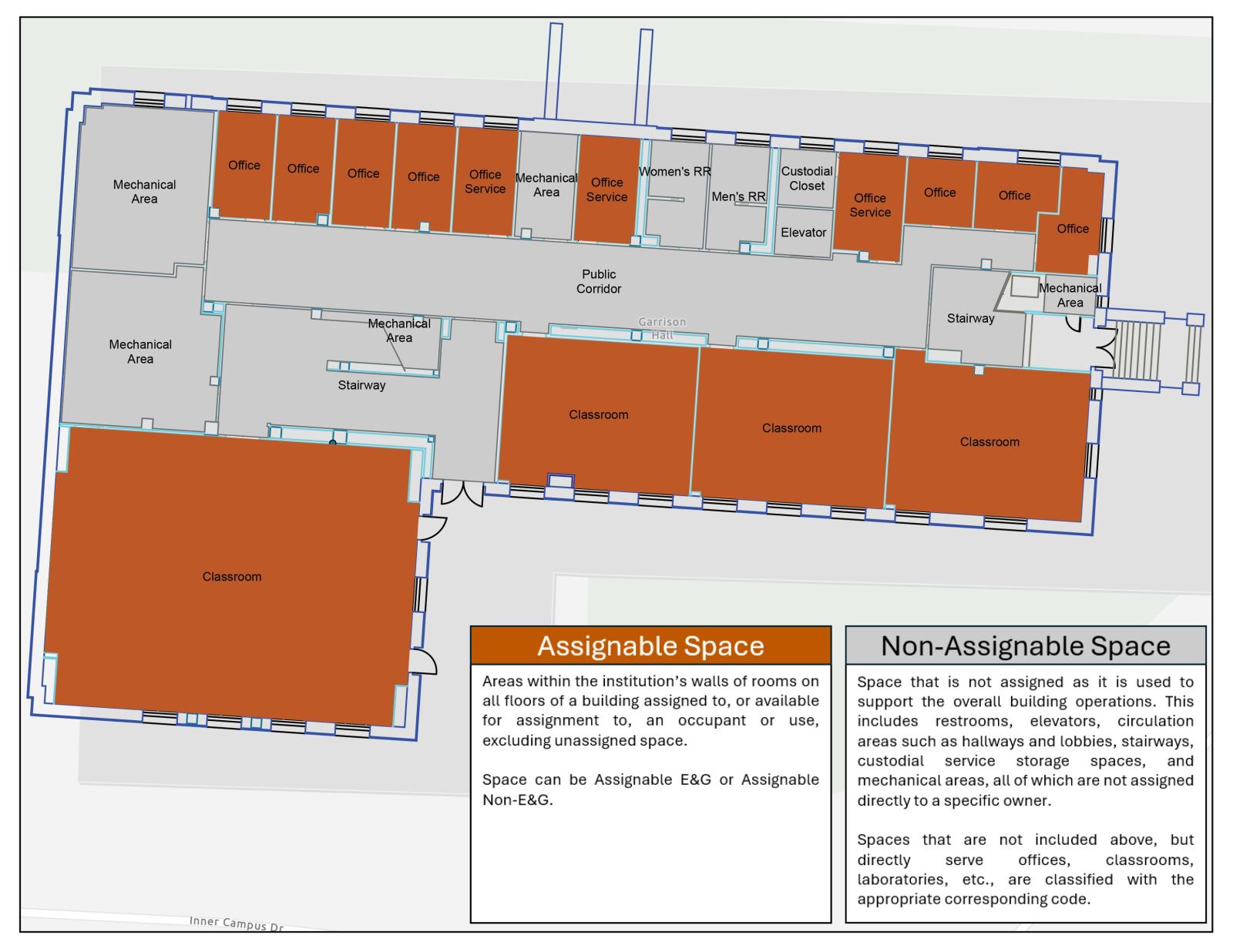
- Assignable space – Areas within the institution’s walls of rooms on all floors of a building assigned to, or available for assignment to, an occupant or use, excluding unassigned space. Space can be Assignable E&G or Assignable Non E&G.
- Non Assignable space - Space that is not assigned as it is used to support the overall building operations. This includes restrooms, elevators, circulation areas such as hallways and lobbies, stairways, custodial service storage spaces, and mechanical areas, all of which are not assigned directly to a specific owner. Spaces that are not included above, but directly serve offices, classrooms, laboratories, etc., are classified with the appropriate corresponding code.
- Unassigned space - Areas within the institution’s walls of rooms on all floors of a building that are not assigned to, or available for assignment to, an occupant or use and are not considered non-assignable space. Space can be unassigned E&G or unassigned Non-E&G.
- Vacant - Similar to unassigned space, vacant space refers to areas that are currently not in use due to renovation or other circumstances. Spaces are not assigned to, or available for assignment to, an occupant or use and are not considered non-assignable space.
How are space percentages evaluated?
Campus Operations and Planning uses annually approved SPACE data as the authoritative source for evaluating building utilization and space designations.
Non-assignable space, unassigned space, vacant rooms, and inactive areas are excluded from calculations.
Buildings are generally categorized as:
- Predominantly E&G: 90% or more E&G assignable space.
- Predominantly Non-E&G: 90% or more Non-E&G assignable space.
- Mixed-Use: More than 10% and less than 90% E&G assignable space.
For mixed-use buildings, funding responsibilities may require proportional evaluation and additional review depending on occupancy arrangements, service applicability, and operational circumstances.
Existing MOUs, MOAs, service agreements, and other special arrangements may also affect funding responsibilities.
What is a mixed-use building?
A mixed-use building is generally one where neither E&G nor Non-E&G space exceeds 90% of assignable space.
In these situations, both E&G and Non-E&G stakeholders may be identified, and funding responsibilities may be evaluated proportionally based on assignable space percentages and applicable services.
Certain facilities may require additional review based on occupancy arrangements, operational purpose, or existing agreements.
Disclaimer
This information is provided for planning, awareness, transparency, and stakeholder engagement purposes only and should not be considered a bill or final funding determination. Information shown reflects current methodologies, assumptions, and planning considerations that continue to be evaluated and refined. Existing MOUs, MOAs, service agreements, and other special arrangements may affect service delivery and funding responsibilities. Information may be updated as analyses are completed and stakeholder feedback is incorporated.